
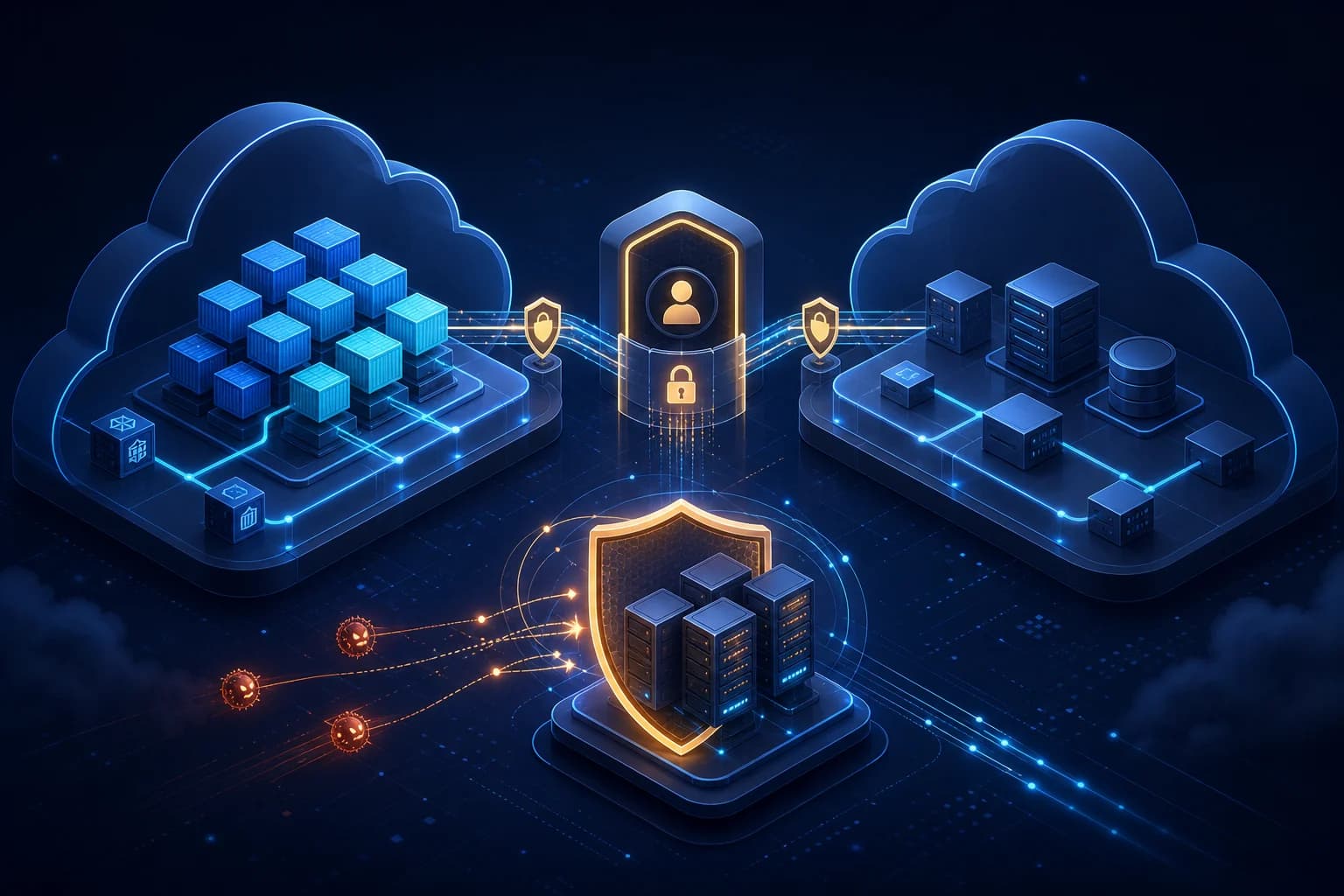
Why these AWS security trends matter now
On June 29, 2026, the AWS Customer Incident Response Team published an update to its Threat Technique Catalog for AWS. The update emphasizes container security, organization-level trust, compute hijacking, S3 data collection, and federated access. These are useful study signals because they show how real cloud incidents cross service and account boundaries.
This is not an announcement that AWS has changed the CLF-C02 or SAA-C03 exam blueprints. It is a practical way to connect current threat behavior to durable certification concepts: least privilege, shared responsibility, centralized logging, identity boundaries, network controls, and the Well-Architected security pillar.
Cloud Practitioner learners should focus on the purpose of the services and controls. Solutions Architect Associate learners should go one level deeper and ask how the design limits access, detects abuse, isolates workloads, and reduces the blast radius of a compromised identity or task.
Trend one: attackers are targeting container control planes
Containers do not remove the need to secure identities, images, networks, secrets, and runtime activity. In Amazon ECS, a task execution role and a task role serve different purposes. Overly broad permissions can turn one compromised task or deployment path into access to unrelated AWS resources.
The June catalog update describes compute-hijacking techniques involving unauthorized ECS tasks. For a certification learner, the important pattern is not a single command. It is the control chain: who can register or run a task, which image is allowed, which role the task receives, where its logs go, and what network destinations it can reach.
A stronger design uses narrowly scoped IAM roles, controlled deployment pipelines, trusted image sources, private networking where appropriate, centralized logs, and monitoring for unexpected task creation or resource consumption. The same reasoning applies whether a workload runs on ECS, EKS, EC2, or Lambda: execution identity and observability are part of the architecture.
Trend two: cross-account trust is part of the attack surface
AWS Organizations and cross-account roles help teams separate workloads and centralize administration. The security risk appears when a trust policy accepts a broader principal than intended, when an external identity provider is misconfigured, or when a legitimate federated session is difficult to distinguish from unauthorized use.
Remember the two-policy test for role assumption. The caller needs permission to call the role-assumption action, and the target role's trust policy must trust that caller. In multi-account designs, resource policies, service control policies, permission boundaries, session policies, and conditions can further limit what is possible.
For exam scenarios, look for the requested boundary. If the requirement is centralized audit access, use a dedicated role with a narrow trust relationship and read-only permissions. If the requirement is to prevent a member account from using a prohibited service, an organization-level guardrail may be relevant. If the requirement is temporary workforce access, prefer federation and short-lived credentials over long-lived access keys.
Trend three: compute hijacking is an identity and cost incident
Compute hijacking occurs when an attacker uses cloud resources for unauthorized workloads, often for cryptocurrency mining, proxying, scanning, or other resource-intensive activity. The visible symptom may be an unusual bill, but the root cause is commonly a compromised credential, excessive permission, exposed management interface, vulnerable workload, or unmonitored deployment path.
Cost controls alone do not stop the attacker. Budgets, Cost Anomaly Detection, and billing alerts can help surface the event, while CloudTrail, service logs, GuardDuty findings, and configuration history help establish what changed and who initiated it. Containment may require disabling credentials, stopping unauthorized resources, isolating affected workloads, and correcting the permission or exposure that allowed creation.
This is a good example of defense in depth. Identity controls reduce the chance of unauthorized provisioning, preventive guardrails constrain what can be launched, detective controls shorten dwell time, and cost monitoring provides a separate business signal when technical monitoring misses the first activity.
S3 collection and data staging are still core cloud risks
The catalog update also expands its S3 object-collection guidance. An attacker with valid permissions may enumerate buckets, copy objects, or stage data for later exfiltration without exploiting the storage service itself. That shifts the question from 'is the bucket public?' to 'who can read which objects, from where, and under what conditions?'
Useful controls include S3 Block Public Access, least-privilege identity and bucket policies, encryption, carefully scoped KMS key permissions, data-event logging where the risk justifies it, access analysis, and alerts for unusual read volume or access paths. A private bucket can still be exposed through an overly broad identity policy or a compromised trusted principal.
For Cloud Practitioner, know the difference between service-side protection, identity permissions, and monitoring. For Solutions Architect Associate, expect scenarios that combine bucket policies, IAM roles, KMS authorization, VPC endpoints, replication, logging, and account boundaries.
Where GuardDuty and Security Hub fit
Amazon GuardDuty analyzes supported telemetry to identify suspicious activity and potential threats. AWS Security Hub aggregates and normalizes security findings and helps teams evaluate posture against security standards. Both appear in the current CLF-C02 in-scope service list, so learners should be able to distinguish detection from centralized finding management.
A common exam trap is choosing a dashboard or aggregation service as if it directly blocks every attack. Detection, investigation, prevention, and remediation are separate functions. GuardDuty can raise findings, Security Hub can centralize findings, EventBridge can route events, and an automated workflow can invoke a response—but each component has a different responsibility.
The architecture question is how quickly a meaningful signal becomes a controlled action. High-confidence findings may justify automatic isolation or credential revocation. Lower-confidence findings may require human approval. Either way, log retention, ownership, escalation paths, and rollback should be designed before the incident.
A certification-focused review checklist
First, draw a three-account example with a workload account, a security account, and a log archive. Mark which principals can assume which roles, where CloudTrail logs are stored, and which organization controls prevent accounts from weakening the design.
Second, take an ECS workload and list its build identity, deployment identity, task execution role, task role, network path, secret source, image source, and log destination. If one element is compromised, identify the maximum blast radius and the control that reduces it.
Third, practice classifying services by job. Use IAM and organization policies for authorization and guardrails; CloudTrail and service logs for evidence; GuardDuty for threat detection; Security Hub for finding aggregation and posture; Config for configuration history and evaluation; Budgets and cost anomaly tools for financial signals.
Finally, reread the official exam guide for your certification. Current security news should deepen your understanding of blueprint concepts, not replace the published scope or tempt you to memorize every newly announced AWS product.
What to take away
The most useful lesson from the June 2026 AWS update is that cloud security incidents are relationship problems. A container receives an identity, an account trusts another principal, a workload can create compute, and a storage policy permits data access. Attackers look for the weakest connection across that system.
Certification questions simplify the environment, but the same reasoning holds: identify the asset, follow the trust path, choose the control that matches the requirement, and preserve enough evidence to verify the outcome. That method is more durable than memorizing a list of product names.
FAQ
Did AWS change the CLF-C02 or SAA-C03 exams in June 2026?
AWS's threat catalog update does not itself announce an exam blueprint change. Use it as current context for stable topics such as identity, logging, least privilege, monitoring, data protection, and secure architecture, while treating the official AWS exam guide as the source of truth for exam scope.
Do Cloud Practitioner learners need to know AWS Continuum?
AWS Continuum is a newly announced offering and is not listed in the current CLF-C02 in-scope services page. Cloud Practitioner learners should prioritize the published exam guide and understand established services such as IAM, GuardDuty, Security Hub, CloudTrail, Config, and S3 before studying preview products.
What is the difference between GuardDuty and Security Hub?
GuardDuty is a threat-detection service that analyzes supported data sources for suspicious activity. Security Hub centralizes findings from AWS and supported third-party services and evaluates security posture. Detection and aggregation are related but distinct jobs.
What should SAA-C03 learners practice from this update?
Practice scenarios involving cross-account role assumption, least-privilege task roles, centralized logging, S3 and KMS permissions, organization guardrails, network isolation, threat findings, and containment choices. Focus on design tradeoffs and blast-radius reduction.
Practice AWS architecture decisions
Apply these identity, storage, monitoring, and secure-design concepts in CertVector's AWS Solutions Architect Associate question sets.
Start SAA-C03 practiceOfficial sources
Use the certification provider's current guidance as the final authority for exam scope, policies, and dates.
Next steps
Related articles
Related tracks
Back to resourcesLearner discussion
Ask clarifying questions or share study notes. Comments are not reviewed CertVector explanations.
No discussion yet. Start with a specific question or clarification.